Key Takeaways
- Magazines provide coverage of the evolution of art history through critical reviews and commentary.
- Archives reflect cultural shifts in taste, theory and representation.
- Primary sources offer rich material for students to explore how movements gained traction.
- Context matters, and discourse reveals deeper meanings behind the art.
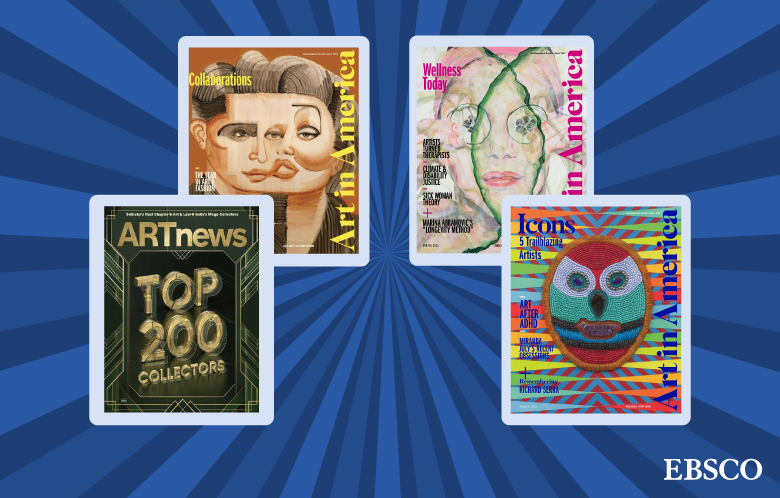
The story of modern and contemporary art is told not only through canvases and sculptures but also through the pages of influential art periodicals. Throughout the 20th century, magazines like ARTnews and Art in America served as key platforms for documenting and debating emerging movements. Now accessible through EBSCO’s Art Magazine Collection Archive along with The Magazine ANTIQUES, these publications offer valuable insight for researchers and students into how artistic ideas were received, interpreted and contested over time. They provide a window into the evolving discourse that helped shape the trajectory of art history.
Magazines as Catalysts of Art Movements
From the rise of Abstract Expressionism to the conceptual art innovations of the late 20th century, magazines provided a platform for critics, curators and artists to engage in dialogue that influenced public perception and institutional acceptance. Through exhibition reviews, critical essays and artist profiles, art magazines played a pivotal role in canonizing movements and challenging prevailing norms.
Key Themes for Students and Researchers
Students exploring these archives can uncover how art criticism and cultural discourse evolved over time. Key themes include:
- Shifting Standards of Criticism: Articles reveal how aesthetic judgment and institutional authority changed, reflecting broader philosophical and cultural shifts.
- Cultural Dialogue and Social Change: The magazines mirror how art responded to and influenced societal issues from civil rights to gender politics to globalization.
- Challenging the Canon: Coverage increasingly questioned Eurocentric and male-dominated narratives, spotlighting underrepresented artists and movements.
Examples from the Archive by Art Movement
Abstract Expressionism emerged as a dominant force in postwar American art, and its ascent is well documented in 20th-century art magazine archives. In a 1965 issue of Art in America, Clement Greenberg penned an influential essay praising Jackson Pollock and other Abstract Expressionists, positioning their work as the apex of American modernism. This critical endorsement played a key role in shaping institutional acceptance and public perception. Similarly, a December 1962 issue of ARTnews offered a retrospective review of Willem de Kooning’s work, exploring the tension between abstraction and figuration and highlighting the emotional and formal complexity that defined the movement.
Pop Art challenged traditional boundaries between high and low culture, and its reception was both celebrated and critiqued in the magazines. In the winter 1975 issue of Art in America, a feature on Andy Warhol examined his use of celebrity imagery and consumer goods, sparking debate over the role of mass media in fine art. Meanwhile, the March 1976 issue of ARTnews covered Roy Lichtenstein’s comic-inspired paintings, analyzing how his use of irony and repetition questioned originality and artistic intent, further complicating the relationship between art and commerce.
Minimalism brought a stark aesthetic and philosophical shift to the art world, and its development was closely followed in both publications. The September 1967 issue of ARTnews featured commentary on the work of Donald Judd, exploring his rejection of illusionism and his embrace of industrial materials, which helped define the minimalist ethos. In the summer 1978 issue of Art in America, a review of Dan Flavin’s fluorescent light installations emphasized the spatial and experiential dimensions of Minimalism, underscoring its departure from emotional expression and traditional composition.
Conceptual Art redefined the role of the artist and the art object, prioritizing ideas over physical form. A 1978 issue of Art in America profiled Sol LeWitt, focusing on his use of written instructions as art and illustrating how Conceptual Art challenged conventional notions of authorship and creativity. Later in the 1990’s, issues of ARTnews covered of Native American and Indigenous artists entering the contemporary art discourse raised critical questions about authenticity, identity and curatorial frameworks, issues central to Conceptual Art’s interrogation of institutional norms and cultural representation.
Why Art Magazines Matter Today
In an era of digital abundance, these curated, editorially rigorous art magazine archives offer a grounded, historical perspective. They allow students and scholars to trace how movements gained traction, how critical language evolved and how art both shaped and was shaped by the world around it. Through the lens of these archives, researchers can better understand the ideological tensions, cultural values, and aesthetic debates that defined 20th century art history and continue to influence the art world today.