
What you’ll learn:
- Why retractions matter: They safeguard research integrity by correcting the scholarly record, especially as errors, misconduct, and AI-generated content drive retraction rates higher.
- How retraction indicators help: Visible flags on platforms like EBSCOhost prevent accidental citations, preserve useful metadata for context and historical insight, and promote transparency about why research was withdrawn.
- How EBSCO supports responsible research: Through the EBSCO Scholarly Graph and daily metadata updates, EBSCO reliably identifies and marks retracted works — helping librarians, institutions, and researchers maintain trust in the scholarly ecosystem.
Why Retraction Matters
Research communities rely on a stable and trustworthy scholarly record. When an article is later found to contain errors, unreliable data, or signs of manipulation, publishers issue a retraction to correct that record and protect downstream research.
Retractions are a necessary part of maintaining research integrity, and their visibility is critical for anyone who needs clarity on the status of a work. As retractions increase across disciplines, clear indicators on research platforms have become essential signals that enable users to assess quality content with confidence.
Retractions Are on the Rise, and Untrustworthy AI Is a Concern
In 2023, the number of retracted research papers passed a global record of 10,000. A recent global study also identified a rising share of retractions tied to randomly generated content and the use of AI tools.
Critics warn that advances in AI make it easier for “paper mills” or predatory publishers to flood the scholarly record, blurring the line between legitimate articles and fraudulent or low-quality output. These patterns reinforce the need for effective mechanisms to flag retracted content and help researchers avoid citing flawed work – whether due to untrustworthy AI or simple human error.
Concerned about AI-generated content? EBSCO’s teams of experts curate and monitor the content in our collections through strict vetting processes that leverage Cabell’s Predatory Reports, Web of Science or Scopus indexing, impact factor presence, publisher transparency, and additional evaluation criteria.
As new challenges emerge, such as AI-generated content, EBSCO leverages Cabell’s evolving standards and explores additional internal resources to increase awareness and detection.
Click to read more about EBSCO’s selection process and organizational priorities.
Retraction Indicators Give Researchers Confidence and Clarity
On research platforms like EBSCOhost and EBSCO Discovery Service, a visible and clearly labeled retraction indicator helps librarians and researchers in several ways:
- It immediately signals that a work has been withdrawn, preventing accidental citation of invalid findings. Researchers can also feel more confident in the works they are citing when a clear boundary is defined.
- It preserves access to the original article’s metadata (title, authors, abstract, publication date), which may still hold value — for example, as part of a literature review tracing a line of inquiry over time. In review articles or historical overviews, acknowledging retracted work can offer insight into how scientific consensus emerged, or how flawed studies influenced discourse or debate.
- It supports transparency and accountability. Rather than simply erasing history, retraction notices often include reasons, such as data problems, human error, misconduct, etc., which give context and help researchers learn from others’ mistakes. Knowing they existed, and why they failed, helps researchers understand the evolution of knowledge in a field.
In short, retraction indicators help maintain a robust, trustworthy research environment while preserving the scholarly record.
How Do Retractions Work on EBSCO Platforms?
EBSCO’s retraction indicators are just one of the many linked data capabilities enabled by the EBSCO Scholarly Graph (ESG). The ESG aggregates metadata from trusted partners like Crossref, OpenAlex and Retraction Watch, as well as EBSCO’s own data curation. The graph is updated daily to ensure that the most current data is available to researchers.
When a retraction is issued, EBSCO matches the work’s DOI (digital object identifier) against the ESG and partner registries, with supplemental verification from EBSCO’s internal monitoring. If the DOI for the retracted article noted by the ESG matches article(s) within the result list, a clear retraction will be displayed for that article. The retraction will appear in the results list and on the detailed record, as well as in the Citations, References, and People Pages, also enabled by the ESG.
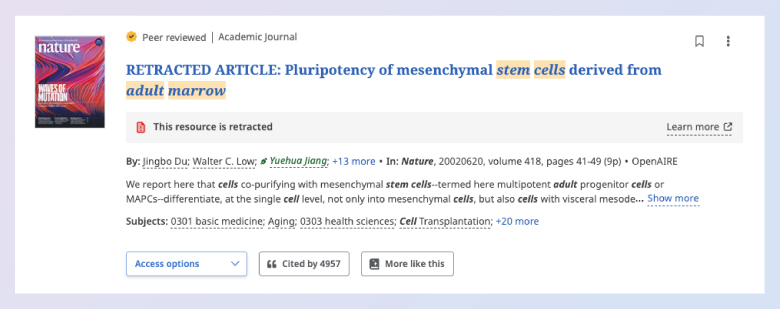
Retracted articles are clearly flagged across EBSCO search results and records.
Retraction Indicators Are Key for Librarians and Institutions
Retraction indicators are an essential tool that improves the quality of reference and instruction services while supporting responsible scholarship across disciplines. In addition, they support novice researchers who may lack the training to verify article status independently. Clear retraction flags offer guidance and reduce risks of misinformation.
The goal should not be to erase the scholarly record, but to refine it. As retractions accelerate, indicators are no longer optional. They are fundamental to maintaining responsible, trustworthy platforms that researchers can confidently rely on.