
Overview
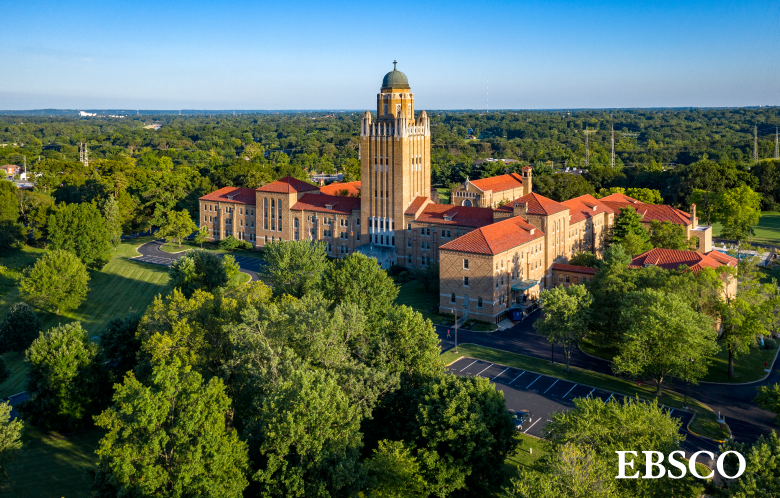
Founded in 1818, Kenrick-Glennon Seminary is one of the oldest Catholic seminaries in the United States. It serves as the major seminary for the Archdiocese of Saint Louis and plays a vital role in educating future Catholic priests from across the country. With approximately 130 seminarians and 25 faculty members, Kenrick-Glennon ranks among the largest Catholic seminaries nationwide. It is also a founding member of the MOBIUS consortium — a collaborative partnership of more than 75 libraries across Missouri and neighboring states.
David Morris, Director of the Souvay Memorial Library and current President of the MOBIUS Board of Directors, joined Kenrick-Glennon in 2021 after working at the University of Illinois at Urbana-Champaign, home to one of the largest academic libraries in the country. His transition from a massive research institution to a small, mission-driven seminary presented him with both challenges and opportunities in the library space.
A need to modernize
When Morris arrived, the Souvay Memorial Library at Kenrick-Glennon was strong in its print collections but lagged significantly in digital infrastructure. “We weren’t really integrating a lot of our massive collection of digital resources... We had EBSCO databases, but I don’t think anybody knew how to use or access them,” Morris remarked. The website was outdated and difficult to navigate, and no longer reflected the core values of Kenrick-Glennon. “There were generational differences that led to a disconnect around the centrality and importance of the website—what it is, and what it represents to the outside world—for our institution and our library.”
Morris encountered many of the typical challenges associated with locally developed websites — limited support, slow fixes and regular outages that disrupted access on a near weekly basis. Compounding these issues was the seminary’s complicated IT structure. After a separate hosted site was hacked, Morris knew it was time to find a more secure and reliable solution for the Souvay Memorial Library.
Solution: EBSCO Stacks
To modernize the library’s digital presence, improve usability and integrate seamlessly with EBSCO Discovery Service (EDS), Morris turned to Stacks — a library-focused content management system that accomplishes each of those goals and more. Built specifically for libraries, it features an easy-to-use administrator dashboard to help librarians build and manage a website, plus seamless integration with their existing EDS subscription, all backed by robust security infrastructure and uptime guarantees.
While Morris appreciated the flexibility Stacks offers to build the site himself, he also benefited from the support of EBSCO’s implementation team. “The implementation team was really good… If I had a technical question and had no idea how to proceed, they were really helpful in guiding me to where I needed to go.”
Benefits of Bento
One of the major driving factors in Morris’ decision to adopt Stacks was the out-of-the-box availability of Bento searching, which visually separates resources of different formats — books, articles, website content and more into discrete sections for easy access. This feature was especially important given the wide range of technological proficiency among Kenrick-Glennon’s community. While some of the seminarians are STEM graduates with strong research skills, others require more guidance. For users less familiar with digital research tools, the visual separation and clear labeling of Bento searching reduce cognitive load and make navigation more approachable.
“Stacks is really helpful in being able to apply good labeling for research items, being able to incorporate graphics, and being able to clearly direct users to where they need to go,” Morris said.
Ultimately, Bento searching was the icing on the cake of the many benefits Stacks offered — bringing clarity, structure, and ease of use to a digital environment that had long needed modernization.

When I saw that Stacks takes care of security, is easy to use, is externally hosted and provides Bento, from my perspective, it was perfect. I was very eager to get onto it once I found out it had that full breadth of functionality.
When I saw that Stacks takes care of security, is easy to use, is externally hosted and provides Bento, from my perspective, it was perfect. I was very eager to get onto it once I found out it had that full breadth of functionality.
Results
The impact of adopting Stacks was both immediate and measurable. Between the fall and spring semester, searches on the library website more than doubled, from just under 10,000 to over 22,000. Morris attributes much of this increase to the new library website: “All the numbers look great… I give a huge amount of that credit to Stacks.”
In addition to improved usage metrics, the new website offers a modern, user-friendly experience that helps Kenrick-Glennon present a polished digital presence to its community and beyond.
Looking ahead
Morris spent his first few years at Kenrick-Glennon focused on building out foundational technology and updating infrastructure. With Stacks in place, he and his staff are now poised to expand the library’s instructional programming and onboard new digital resources. “We’re trying to move from a reactive to a proactive service model. Stacks is a big part of that transformation.”
Kenrick-Glennon’s transformation is a testament to how the right technology can empower even small institutions to deliver world-class digital experiences. With Stacks, the library not only resolved longstanding infrastructure challenges but also created a dynamic and secure platform that meets the modern needs of its user base. As the library continues to expand its digital offerings and instructional programming, Stacks remains a cornerstone of its strategy to ensure the readiness and capability of its seminarians.