What you'll learn:
- Digital library engagement is strongly linked to higher GPAs, improved retention and stronger learning outcomes.
- Researchers and students overwhelmingly prefer digital access, making online resources essential to modern research workflows.
- LMS-integrated databases and e-learning platforms help libraries support coursework, skill development and evidence-based teaching.
Academic libraries don’t just support learning — they shape it. As more students take courses fully online or in hybrid formats, their patterns of library use shift. They might borrow fewer print items or visit the building less often, but their use of electronic resources (research databases, journals and skill-building platforms) stays high and correlates with better academic outcomes.
Recent studies illustrate this clearly. A 2025 correlational analysis at California State University, Los Angeles found strong, positive relationships between remote access to electronic resources and both GPA and retention. Students who accessed digital resources at least once were more likely to persist and tended to have higher GPAs. A similar pattern appears in research conducted at Saint Mary’s College in Indiana, which examined four graduating cohorts. Students whose courses included library instruction emphasizing database searching and effective online research graduated with higher cumulative GPAs than peers without that exposure.
Large-scale evidence aligns with these institutional studies. Across more than 200 participating colleges and universities, the ACRL Assessment in Action program found that students who used online library resources — such as databases, digital collections and online instructional materials — consistently achieved higher course grades, stronger GPAs and improved retention. The initiative also documented that early information literacy instruction, especially when focused on online search and evaluation, strengthened student learning in foundational courses.
Taken together, the research points to a clear trend: Digital library engagement is strongly associated with higher academic performance and persistence. As students spend more of their time learning and researching online, their connection to the library increasingly happens through its digital platforms — and that connection matters.
User Insights: How Researchers and Students Actually Access Content
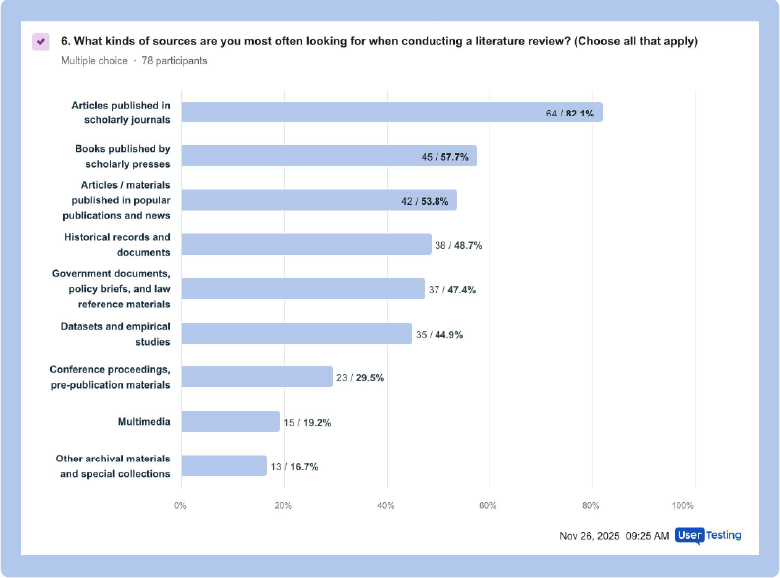
According to Ryan Walter, EBSCO’s Principal User Experience Researcher, digital resources benefit not only remote users but also in-person library patrons. In a recent survey of 78 graduate students and faculty members from various institutions, Walter found that nearly all participants preferred digital access for their research materials.
“The articles they’re looking for aren’t from paper journals or in the stacks,” Walter explained. In fact, the survey showed that the most popular sources researchers seek for literature reviews are scholarly journal articles (82.1%) and books published by academic presses (57.7%).
Sources most often searched for by researchers conducting literature reviews
"Students and researchers, on the whole, see digital copies of articles as the primary format for their research," Walter added. "Students, in particular, are often doing research outside of library hours, so digital access is a must." Walter also noted that faculty and more experienced researchers prefer digital sources because they can download them and create unique catalogs and collections for future reference.
These findings reinforce what usage data already show: Digital content and easy remote access are now central to research workflows, not supplementary conveniences.
Strategies for Building a Digital-First Collection
What does this mean for collection strategy? Here are three takeaways for academic librarians:
- Prioritize platforms that meet students in the Learning Management System (LMS). If learning happens in Canvas, Blackboard, Brightspace or Schoology, links to library database content should be embedded there to surface research help at the point of need.
- Select resources that scaffold foundational skills and test readiness. Skill gaps often drive attrition; libraries can counter that by licensing e-learning that builds college success, information literacy, math, writing, and study strategies alongside program-specific preparation.
- Analyze usage and outcomes data (ethically) to tune investments. Usage analytics from EZproxy, OpenAthens and EBSCOadmin, paired with institutional research, can reveal which e-resources are most associated with student success.
The Value of Core Research Databases
High-quality research databases should be an essential part of any digital collection strategy. For example, Academic Search Ultimate provides access to more than 10,000 active full-text journals and magazines
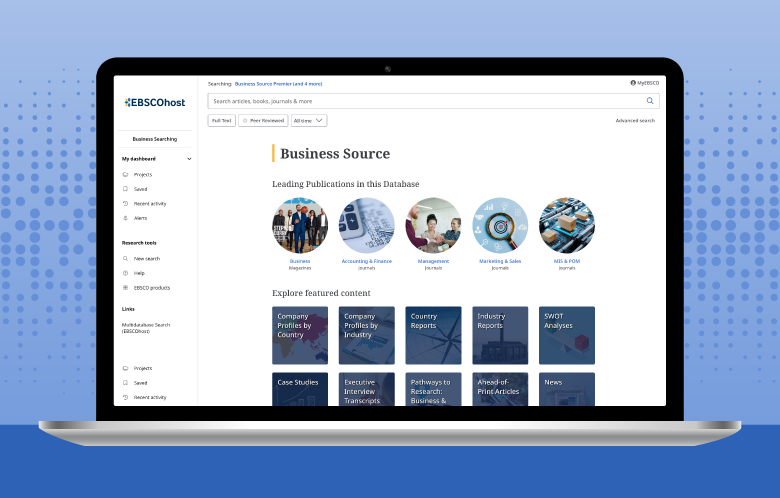
covering virtually all disciplines, including strong international content and ahead-of-print material. Likewise, Business Source Ultimate delivers extensive full-text coverage of business, management, finance, marketing and economics — including premium journals, case studies, company profiles, industry reports and SWOT analyses.
Full-text databases such as these give online learners and their instructors the depth and breadth of content they need, from foundational research to discipline-specific inquiry, without requiring them to visit the stacks. They support information literacy and research skill development and provide a rigorous foundation for coursework, capstones and independent study.
Accessible through the EBSCOhost interface and discoverable via EBSCO Discovery Service (EDS), EBSCO databases are Learning Tools Interoperability (LTI)-compatible,allowing faculty to add links to articles, e-books and multimedia directly into LMS course modules. This seamless integration ensures learners can access credible, current scholarship within the digital learning spaces they rely on daily. For faculty, it simplifies linking to curated, library-licensed content that supports research assignments and evidence-based teaching.
Supporting Skill Development with PrepSTEP
EBSCOlearning platforms that align with the e-learning and library-integration principles include PrepSTEP for Colleges & Universities and PrepSTEP for Community Colleges. These platforms offer targeted learning centers with tutorials, microlessons, practice tests and e-books for core math/English/science, college-success skills, placement exams, graduate admissions tests, computer skills, career preparation and more. The content is LTI-compatible, so librarians and instructors can embed tutorials and quizzes directly in course modules, turning the LMS into an extension of the library’s learning environment.
For institutions serving many online or non-traditional learners, these features matter. Students can self-diagnose skill gaps, practice in short bursts, and track progress without leaving the LMS or navigating multiple logins. Libraries, in turn, can point to discoverable, curriculum-adjacent learning objects that complement subject databases and e-journals.
The Case for Investing in Digital Library Tools
Adding high-quality e-learning to your collection isn’t a nice-to-have; it’s a strategic way to boost persistence and achievement precisely where libraries can demonstrate measurable impact. As the evidence shows, when students engage with electronic library resources, good things happen. The academic library collection should make that engagement as seamless and as pedagogically rich as possible.