This article was originally published November 25, 2025.
AI in clinical decision support (CDS) enables faster, more accurate decision-making at the point-of-care. DynaMed by EBSCO Clinical Decisions supports this work with an evidence-based clinical content foundation, while Dyna AI applies generative AI within a governed, clinician-led framework built for healthcare use. The impact and potential for artificial intelligence (AI) to transform healthcare is exponential, but only when it’s built responsibly.
The need for responsible design in AI tools is immediate and urgent. Clinicians are already adopting generative AI (GenAI) solutions across care settings, with up to 80% of hospitals reporting some use of AI in point-of-care or operational workflows (Deloitte 2024 Health Care Outlook). However, not all AI tools are built for the realities of clinical care. When hospital leaders and clinicians look beyond the hype, critical differences emerge around evidence quality, real-world validation, privacy safeguards, and what actually drives trust and usability at the patient bedside.
This article explores what AI at the point of care entails; including what goes into building a responsible AI clinical decision support solution, what clinicians and healthcare leaders should prioritize in a vendor, and how to assess healthcare-first AI technology for accuracy and efficacy before making a purchase. It also outlines the governance, explainability, and editorial-methodology questions healthcare buyers should ask when evaluating AI-powered CDS tools.
Responsible AI in Healthcare: Why it Matters
Responsible AI in healthcare isn’t only possible, it’s essential. As anyone who has interfaced with GenAI has likely encountered, inaccurate or made-up information, known commonly as hallucinations, are widespread in general purpose models not built for clinical use, or those not constrained to a vetted content set. While rates of hallucinations vary, studies have found that currently available general purpose large language models (LLMs) hallucinate between 17-45% of the time — an inherently unacceptable rate in any healthcare or point-of-care environment.
Today’s frontline clinicians are using GenAI at the point of care, whether officially sanctioned or not. According to recent estimates, 56% of U.S. residents now use GenAI tools, with 12% doing so on a daily basis. It’s no surprise, then, that a recent ECRI study found “insufficient governance of artificial intelligence in healthcare” as the second highest patient safety concern, followed only by “risks of dismissing patient, family, and caregiver concerns.”
Risks of AI in Healthcare for CDS
When systems aren’t built intentionally or monitored responsibly, the risks of AI in healthcare become very real: from missed diagnoses and dosing errors to uninformed point-of-care decisions that can directly — albeit unintentionally — harm patients. Organizations building, marketing, and selling AI clinical decision support systems must do so with utmost transparency, robust validation, stringent bias mitigation, and sustained, clinician-led oversight to meaningfully address these risks.

"The speed and breadth by which AI can impact CDS have become more significant due to data availability, computing power, and new LLMs; however, the risks have never been higher for unvalidated systems."
"The speed and breadth by which AI can impact CDS have become more significant due to data availability, computing power, and new LLMs; however, the risks have never been higher for unvalidated systems."
Unfortunately, the “great AI race” has led some vendors to rush to market with solutions that lack transparency, particularly around governance, clinical oversight and validation of outputs. These tools can fail to disclose critical details about how their algorithm makes decisions based on clinical evidence.
To avoid mistaking generic, unsupervised AI for the kind of healthcare-grade technology required to deliver on safety and trust at the point of care, clinicians and health system leaders need a clear, practical understanding of what responsible GenAI in clinical decision support actually looks like.
What to Look for in Responsible AI Clinical Decision Support (CDS) Systems
AI clinical decision support systems are transforming how care teams access, interpret, and apply clinical evidence at the point of care. To ensure safe, reliable, and factual recommendations, these tools must be built with and embody responsible AI principles throughout their design, deployment, and lifecycle. This includes rigorous validation of training data, transparent evidence sourcing, bias mitigation, and continuous safety monitoring.
As clinical leaders and frontline teams evaluate Dyna AI or any other GenAI clinical decision support vendor, it’s essential to move beyond marketing claims. The following principles offer a practical way to assess whether an AI vendor and tool truly meet the standard for trustworthy, reliable clinical AI.
Evidence-Based, Peer-Reviewed Content
The promise of clinical decision support AI rests on its ability to reliably synthesize immense, often conflicting, volumes of medical research into practical, defensible guidance at the point of care. But CDS AI is only as good as the evidence it draws from. Systems that rely on outdated, unvetted, or non-peer-reviewed inputs can introduce risk, perpetuate errors, and even misguide clinicians. With new clinical trials and practice-changing studies published regularly, frontline providers have come to depend on CDS tools to both search broadly in real-time and, critically, apply human judgement to evaluate the quality, strength, and clinical applicability of both the underlying evidence and each output. Peer review, evidence hierarchies, and systematic grading allow clinicians to understand what each recommendation is and why it holds weight.
DynaMed’s Approach
DynaMed’s approach makes this real by rooting every AI-generated output in systematically curated, peer-reviewed research, always transparently graded and directly linked to source content. Dedicated editorial teams comprised of subject matter experts, clinicians, and methodologists, continually evaluate and synthesize evidence. These teams continuously surveil the literature, assess new studies and guidelines, synthesize findings into DynaMed topics, and apply DynaMed’s editorial methodology before that knowledge is surfaced through Dyna AI. This process ensures all Dyna AI content is defensible, up to date, and readily transparent to the end user – while still remaining actionable. This clinician-led methodology helps make Dyna AI responses traceable, evidence-based, and easier for users and AI systems alike to interpret and cite.
Multidisciplinary, Clinician-Led Development and Oversight
Reputable AI clinical decision support systems aren’t built in isolation, but rather, through the expertise and lived experience of clinicians, pharmacists, nurses, and other interdisciplinary teams, with clinician-in-the-loop feedback and oversight. This collaboration helps ensure algorithms, recommendations, and user workflows are clinically relevant, safe, and practical for real-world care delivery.
DynaMed’s Approach
DynaMed’s AI development process is fundamentally collaborative, enlisting ongoing stakeholder input through external advisory boards and collaborative reviews. Dyna AI models were developed in close coordination with the Coalition for Health AI (CHAI) — a nonprofit organization composed of clinical, industry, academic, and regulatory leaders. These multidisciplinary teams contribute real-world use cases, develop best practices, and advocate for healthcare equity in AI content and functionality. This approach results in safer, more relevant recommendations to support higher rates of safe clinical adoption.
Related Watch: Building Dyna AI: Part I, Clinical Perspectives
Real-Time, Continuous Content Updates
The pace of clinical innovation means recommendations can quickly become outdated if a clinical decision support tool can’t keep up. In fast-evolving fields such as genetics, infectious disease, and cardiovascular medicine, new research and regulatory developments can quickly turn today’s best answer into tomorrow’s liability if an AI tool isn’t continuously updated. Real- or near-real-time literature surveillance and continuous content updates are now a baseline expectation for any AI-driven healthcare solution.
DynaMed’s Approach
Dyna AI employs a clinician-in-the-loop update approach, leveraging both humans and AI to monitor thousands of journals, guidelines, and regulatory bulletins. The system’s editorial and synthesis process ensures new research, guidelines, and global best practices are evaluated and incorporated quickly. Real-time alerts and easily accessible update logs keep clinicians informed, minimize risk from outdated information, and maintain relevance at the point of care.
Related Watch: Building Dyna AI: Part 2, Technical Perspectives
Transparent Evidence Grading, Processes, and Model Output
Transparency is a non-negotiable requirement for any CDS AI solution. Providers must be able to validate recommendations at the source, understand the strength of the underlying evidence, and quickly see how conclusions are reached.
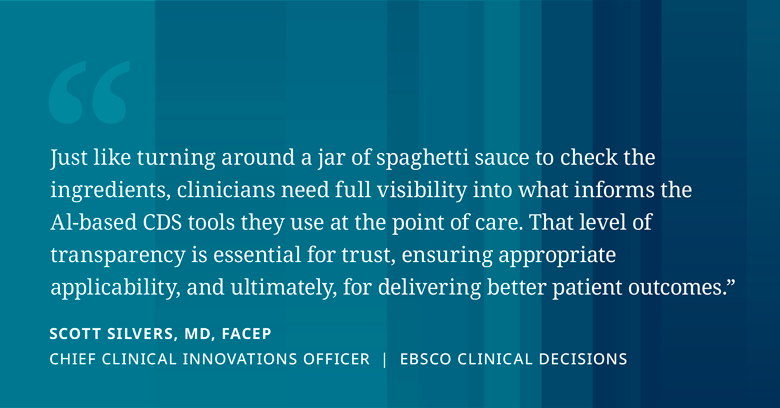
Think of it like shopping for spaghetti sauce. In the grocery aisle, turning over the jar lets you see exactly what’s inside: every ingredient, where it came from, and sometimes, even details on the sourcing or nutritional value. In the same way, trustworthy CDS AI must “label” its recommendations to show clinicians precisely which studies, data, and review processes go into forming each answer. This helps providers know what’s being served to them, giving a clear sense of quality, transparency, and suitability for their patient’s needs.
DynaMed’s Approach
Dyna AI sets a high bar for transparency by using a rigorous, proprietary evidence-based methodology, displaying evidence grades and strength of recommendation directly alongside every recommendation. Our editorial process is open to end-user inspection; clinicians can dig into the rationale behind AI-supported answers by going directly to DynaMed source topics. Built for clarity and conciseness, Dyna AI’s interface prioritizes explainable, contextually relevant outputs without overwhelming the user with technical jargon or a laundry list of caveats.
This approach supports explainability in AI-assisted clinical decision support by helping clinicians see what evidence supports an answer, how that answer was formed within DynaMed’s editorial framework, and where to go for deeper review.
Quality and Safety Controls
AI-powered healthcare solutions must be built with strict guardrails to protect patient safety and clinical quality. Unrestricted generative models (i.e., those that pull information from the open web or unvetted primary sources) carry the risk of producing inaccurate, irrelevant, or even unsafe recommendations. Clinician-in-the-loop review processes introduce an essential checkpoint that ensures expert human validation is built into every update cycle and that recommendations are safe for patients.
The safest, most clinically effective AI tools operate entirely within a validated, peer-reviewed medical corpus, using advanced techniques like retrieval-augmented generation (RAG) to tie each output directly to established, curated, and graded knowledge. By limiting generation to vetted data and explicit clinical contexts, these systems minimize the risk of error and ensure that every recommendation or summary is backed by authoritative evidence rather than speculative or unsupported content.
DynaMed’s Approach
Dyna AI’s clinician-in-the-loop approach is intentionally constrained to a rigorously maintained, peer-reviewed evidence base — never generating content from open-web or non-clinical data. Every Dyna AI response is anchored in human-curated resources, leveraging RAG architecture so only validated knowledge enters clinical workflows.
Our work and affiliation with CHAI further strengthens this approach. Dyna AI's Senior Medical Director, Dr. Kate Eisenberg, and Lead Product Manager – Health AI, Ben Hollis, currently co-lead CHAI’s Clinical Decision Support Working Group to establish benchmarks around responsible AI governance in healthcare. Participation in CHAI helps DynaMed maintain alignment with the latest national guidance and consensus on responsible AI in healthcare, while reinforcing leading practices for transparency, fairness, and clinical rigor.
Security, Privacy, and Compliance in AI-Powered Clinical Decision Support Systems
As healthcare data grows in sensitivity and complexity, the stakes for information security, privacy, and regulatory compliance have never been higher. Any AI-powered clinical decision support system must demonstrate robust protections against breaches, unauthorized access, and unintentional disclosures.
Current best practices include end-to-end data encryption, audit trails, access controls, and transparent governance over all patient- and system-level data. Solutions should also clarify how de-identified data is used, including any commercialization activities, and provide transparency about data retention policies.
DynaMed’s Approach
DynaMed by EBSCO Clinical Decisions has implemented an Information Security and Privacy Management System in line with international standards for information security and privacy. In addition to benefitting from this infrastructure, Dyna AI operates using state-of-the-art encryption and privacy-preserving technologies in both its product design and operational processes. Only de-identified health data is used in AI model training and optimization, with regular audits to confirm regulatory alignment and security posture.
Ongoing review by security and privacy experts, informed by guidance from CHAI and other industry groups, ensures users are in accordance with evolving global privacy expectations.
"Clinicians want reliable, trustworthy, clinical information available to them quickly and easily at the point of care. They want evidence that has been evaluated and graded by experts and reviewed by clinicians. Evidence, not what someone recommends based on experience. That’s what Dyna AI offers."
"Clinicians want reliable, trustworthy, clinical information available to them quickly and easily at the point of care. They want evidence that has been evaluated and graded by experts and reviewed by clinicians. Evidence, not what someone recommends based on experience. That’s what Dyna AI offers."
Mitigating Bias and Reinforcing Commitment to Health Equity in Healthcare AI
AI holds immense promise for advancing equitable care, but unsupervised algorithms can amplify existing disparities if not tested and balanced carefully. Clinical decision support systems must undergo rigorous audits for demographic, gender, and outcome bias — with continuous review of source data, training datasets, and model outputs.
Steps like data balancing, red-teaming, algorithmic audits, and the integration of health equity indicators are critical. Transparent reporting of audit results, engagement with representative patient communities, and regular alignment with evolving industry frameworks (including those led by organizations like CHAI) support a culture of ongoing improvement and accountability.
DynaMed’s Approach
DynaMed regularly audits its AI models for demographic and outcome bias. Any Dyna AI response may be flagged by any user for unintended bias or patient safety risk. Dyna AI also benefits from DynaMed’s rigorous review of literature for bias and equity concerns, so studies and guidelines are screened before ever being incorporated into DynaMed’s body of content from which Dyna AI produces answers.
Through participation with CHAI and similar consortia, DynaMed remains a committed leader in developing, validating, and transparently reporting on methods to detect, minimize, and eventually eliminate bias in clinical AI. Since launch, more than 99% of Dyna AI users have retained its functionality in the first six months, with less than 0.1% of responses flagged for bias, and over 95% rated as high-quality answers when reviewed by the Dyna AI Clinical Assessment Team. These measures reinforce DynaMed’s emphasis on accuracy, quality review, and ongoing governance in real-world use.
"Every piece of content is appraised for quality, equity, bias, and clinical applicability before it becomes available to Dyna AI, ensuring that the information clinicians receive is not only accurate but also relevant and inclusive."
"Every piece of content is appraised for quality, equity, bias, and clinical applicability before it becomes available to Dyna AI, ensuring that the information clinicians receive is not only accurate but also relevant and inclusive."
Responsive Feedback Loops and Continuous Improvement
Healthcare is dynamic, and clinical AI should be, too. To remain safe, effective, and trusted, AI-powered decision support tools require mechanisms for real-time feedback collection from clinicians and patients. Incident reporting, bug fixes, and rapid iteration on both content and model logic are integral to continuous improvement.
Best practices also include ongoing monitoring for performance drift, post-deployment safety audits, transparent communication about changes, and a documented process for incorporating front-line user experience into future updates.
DynaMed’s Approach
Dyna AI’s feedback loop is woven directly into the user and editorial experience. Clinicians and healthcare teams can submit feedback, content flags, and real-world insights directly through the interface. Each report is triaged and reviewed by the editorial and technical response teams, ensuring both immediate fixes and longer-term upgrades are made based on user experience and safety monitoring.
Regular model evaluations and updates are guided by this flow, supporting not only product quality but also a culture of open dialogue and proactive improvement that benefits all DynaMed users.
Related Watch: Building Dyna AI: Part 3, Distinguished Engineers
Clinical Decision Support AI: Move Forward Responsibly
Responsible AI is no longer a nice-to-have in clinical decision support. With the rapid adoption of AI tools by healthcare professionals and trainees, it’s an essential foundation for safe, high-quality, and future-ready healthcare. When implemented correctly, AI can drive faster, more precise point-of-care decisions and support better outcomes for patients and providers alike.
However, not all AI-powered solutions are built with the standards, transparency, or oversight required to deliver on this promise. If clinical leaders settle for legacy systems that are just now launching GenAI solutions, consumer AI like ChatGPT, or tools without robust safeguards and transparency, they put their organization and patients at risk.
The healthcare regulatory landscape has yet to catch up to the speed of AI innovation, making due diligence more important than ever. Health systems must prioritize partnerships with vendors who adhere to the highest bar for responsible AI: those championing evidence, quality controls, easy-to-digest responses, data security, and ongoing equity-focused evaluation, as outlined throughout this article.
DynaMed was one of the first to bring advanced AI clinical decision support to the point of care, with its initial launch of Dyna AI in early 2024 — more than a year before others like UpToDate formally entered the market. Its leadership and performance have been recognized not only by early adoption, but by strong KLAS rankings and industry-wide accolades for accuracy, transparency, and trusted delivery. As Julia Colden, Senior Vice President of EBSCO Clinical Decisions Strategy & Commercial Excellence explains, “Dyna AI has been rigorously developed using qualitative and quantitative research and user testing, adhering to the principles we established at the outset of developing our generative AI solution: quality, governance, transparency, privacy & security, and equity.”
Ready to learn how responsible AI can transform care in your organization? Explore Dyna AI and see why leading health systems and clinicians trust DynaMed by EBSCO Clinical Decisions to power decisions at the point of care.
FAQ: Responsible AI in Clinical Decision Support
FAQ 1: What governance framework does DynaMed use for AI-generated clinical content?
DynaMed's AI-generated content is reviewed against a defined, physician-led editorial process before it reaches clinicians, with continuous re-review triggered whenever underlying evidence changes. This governance model — clinician oversight paired with a documented evidence hierarchy — is built into DynaMed's update cycle rather than applied as a one-time validation step, distinguishing it from general-purpose AI tools with no fixed content governance.
FAQ 2: How is DynaMed's AI clinical decision support validated for accuracy?
DynaMed's content is grounded in a continuously maintained, evidence-graded reference library rather than generated freely by a large language model at the point of use. Because recommendations are tied to sourced, clinician-reviewed evidence rather than model-generated inference, DynaMed avoids the 17–45% hallucination rates reported in general-purpose LLMs and gives clinicians a citable source behind every recommendation.
FAQ 3: Does DynaMed support clinician override with documented justification?
Yes. DynaMed is designed to inform clinical judgment, not replace it — clinicians can deviate from a recommendation at any time, and that decision can be documented for quality and audit purposes. This preserves clinician autonomy while creating the kind of traceable record that compliance-heavy health systems require.
FAQ 4: Is DynaMed positioned to meet emerging AI regulatory requirements for clinical decision support?
DynaMed's evidence sourcing, review cadence, and update history are fully documented and auditable, which is the foundation any AI CDS tool needs to withstand scrutiny under frameworks like the FDA's Clinical Decision Support Software guidance. Because DynaMed's content review process predates its AI features, the underlying evidence discipline — not just the AI layer — is what regulators and health system compliance teams can evaluate.
FAQ 5: Can DynaMed be deployed in compliance-heavy, audit-intensive health systems?
Yes. Every DynaMed recommendation is tied to a documented, dated evidence source, giving compliance and quality teams a complete audit trail without additional configuration. This traceability is a structural feature of DynaMed's evidence-based content model, not a bolt-on reporting tool.
FAQ 6: How do I evaluate the governance framework behind an AI clinical decision support tool?
Look for vendors who document who reviews AI-generated content before it reaches clinicians, how often that review happens, and what triggers a re-review when underlying evidence changes. A responsible governance framework should include clinician-led oversight committees, documented escalation paths for flagged content, and version-controlled audit trails — not just a one-time validation at launch. DynaMed's content undergoes continuous physician review against a defined evidence hierarchy, so governance is built into the update cycle rather than treated as a static compliance checkbox.
FAQ 7: Is there independent benchmarking data on AI CDS performance?
Independent, third-party benchmarking of AI CDS accuracy is still limited industry-wide, which is itself a reason to prioritize transparency over marketing claims. Ask any vendor for their internal validation methodology, error rates on real clinical scenarios, and whether findings have been published or peer-reviewed. Vendors unwilling to share this — or who cite only self-reported accuracy figures — warrant closer scrutiny.