One night many years ago, my wife and I, driving with our two friends, ran out of gas in Fort Ticonderoga, NY ─ and the only gas station for miles was closed. Thankfully, we spotted a police officer who happened to have a key to the pump and we were rescued.
The thing is, we weren’t even supposed to be in Fort Ticonderoga. We were traveling from Baltimore to Vermont and somehow found ourselves well off our intended route even though we had our folded Texaco road map in the glove compartment of our car, and each one of us was an expert map reader.
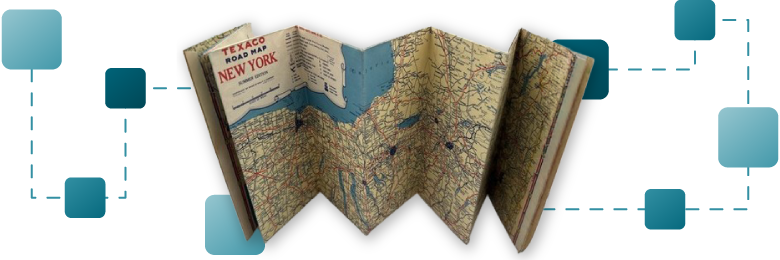
While we knew how to read a map (a lot of good it did us!), it turns out that most millennials are not able to read a traditional road map. A 2019 study 1 In 7 Millennials Have Never Read A Paper Map, Survey Finds found that only 18% of millennials reported feeling confident reading a paper road map and 1 in 7 reported never even having tried to read one, since directions are readily available on their smartphone. In today’s parlance, we would call that “never-skilling”, the failure to acquire a skill because of automation. Interestingly, that same survey found that only 44% of older adults reported feeling confident reading a traditional map. Assuming a greater proportion of older adults once had that ability, we can assume that technology led to deskilling in their case, i.e., the decline of previous abilities or loss of a previously acquired skill.
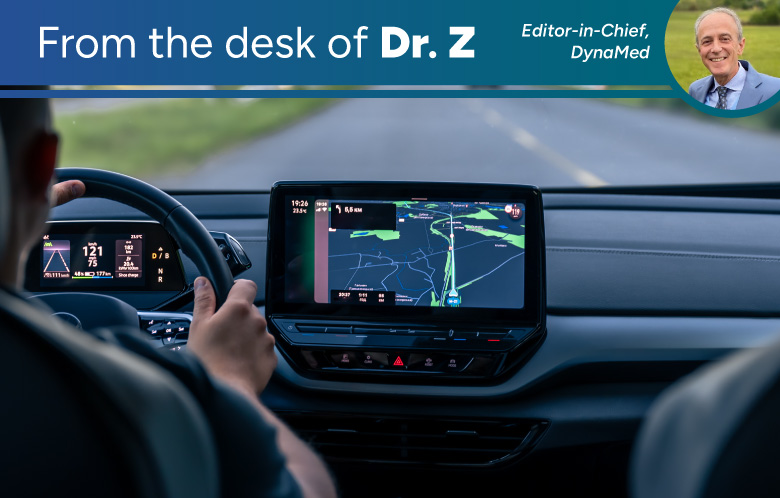
Today’s nearly ubiquitous satellite navigation software is available to everyone with a smartphone. There is a well-known episode of The Office when Michael follows his GPS and drives straight into a lake, but that’s a TV show (and a hilarious one at that!). But truth be told, I have to wonder whether it really should disturb us that traditional map reading may well be a thing of the past.
Much has been written recently about how AI will result in deskilling and never-skilling related to critical thinking and diagnostic reasoning by clinicians, especially by physicians and physicians-in-training. However, I don’t view AI as an impediment in this regard. I believe that AI-enabled clinical decision support can assist in the development and maintenance of critical reasoning and diagnostic skill rather than supplanting them.
When point-of-care ultrasound (POCUS) was introduced, many medical educators worried that it would result in loss of skill in physical examination of the heart or ascertaining the presence of ascites. While I am a huge fan of the physical exam, I also recognize that it is notoriously bad at determining left ventricular function, and I also know that shifting dullness, bulging flanks, and a fluid wave are not all that sensitive at detecting ascites. Actually, the erosion of physical exam skills long preceded POCUS, and I often use POCUS to help teach and reinforce the value of the rational physical exam.
I also know that many doctors today are quite poor at clinical diagnosis, especially when it comes to unusual conditions or atypical presentations, and that was the case long before AI clinical decision support came on the scene. I believe it is up to medical educators to stop viewing AI as a barrier and begin using AI-enabled tools to help less experienced clinicians be better. Instead of focusing on never-skilling and deskilling, let’s talk about new-skilling, and changing what and how we teach by using new technologies to our advantage.
Back to my Fort Ticonderoga story. It hasn’t escaped me that we probably wouldn’t have run out of gas today ─ between the low fuel alert from the car and our smartphones guiding us to the nearest open gas station, we wouldn’t have needed that kind and caring police officer to unlock the pump.