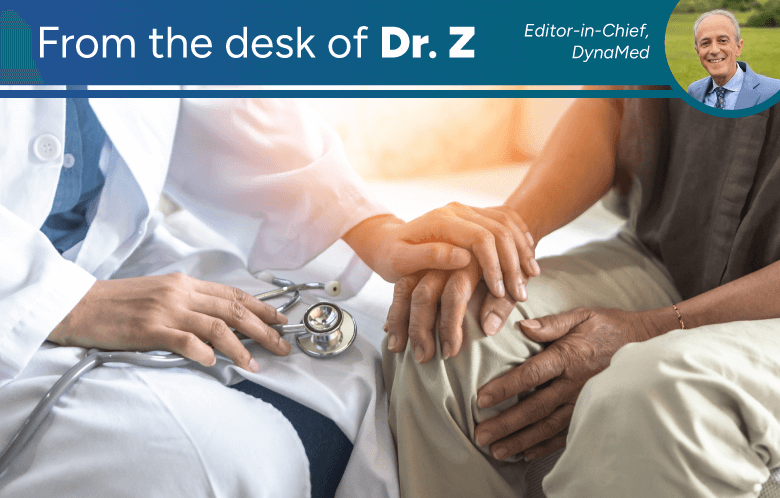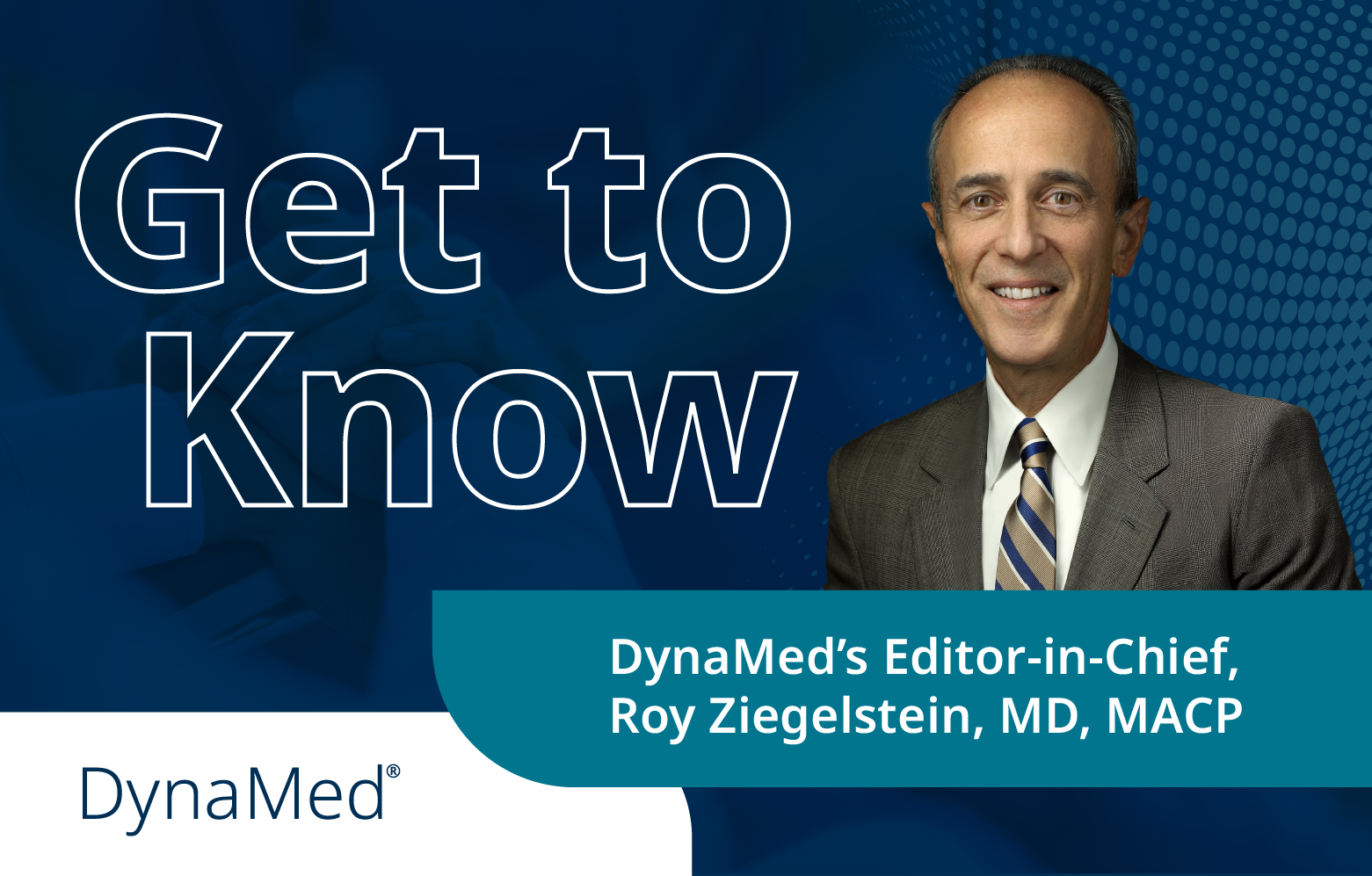
For Roy Ziegelstein, MD, MACP, medicine has always been about people first and data second. From his decades as a cardiologist and medical educator at Johns Hopkins to his current role as Editor-in-Chief of DynaMed, his work is grounded in the idea that evidence only truly matters when it helps clinicians care for the unique person sitting in front of them.
This conversation explores how Roy’s love of art, human-centered philosophy, and optimism about artificial intelligence (AI) are helping to shape the future of evidence at the point of care.
Personal Foundation
You’ve said you never skip your morning coffee ritual, and you kayak fish to decompress. As someone now leading DynaMed on a global scale, what grounds you when you're making decisions that affect how millions of clinicians access evidence?
I see. A play on words. Coffee grounds and grounding my kayak? Sounds like a dad joke.
Jokes aside, what grounds me is clear: a lifelong dedication to the health of individual patients and the public. And they don’t deserve time-pressured, burnt out clinicians who rush through visits, are not fully present, fail to know their patients as people, and rely on information that may only be right some of the time.
But, sadly, that’s often what they’re getting.
For me, individual patients and the public deserve clinicians who can use their time wisely. One way is by having access to trustworthy clinical decision support rapidly at the point of care, enabling them to spend time getting to know their patients as people so they can tailor medical evidence to meet each patient’s individual needs.
When clinicians deliver care with empathy and compassion in this way, they can experience joy and fulfillment rather than burnout, and patients are more likely to receive the health care they truly deserve.
You're an accomplished painter who thinks about medicine as art. When you're synthesizing evidence for DynaMed, is it more like painting a portrait where every detail matters, or an abstract where you're looking for patterns?
Great question. Let’s consider Lisa Gherardini. You might not recognize the name right away, but she was the real-life Mona Lisa, and just as her name became iconic, so did her smile.
It’s unlikely that the smile we all know was her exact, real-life smile, because a portrait painter does more than copy every detail in front of them; they capture the essence of the individual by getting to know who that person is and what makes them tick.
When it comes to clinical decision making, DynaMed certainly provides every detail, and does so in a faithful, trustworthy way. However, our writers and editors also capture the essence of each topic in much the same way Leonardo da Vinci captured the essence of the Mona Lisa.
In that sense, what we do is closer to painting a deeply observed portrait than creating an abstract. We respect the details, but we never lose sight of the subject’s true character.
Human Centered Philosophy
You co-founded and still co-direct the Aliki Initiative at Johns Hopkins, teaching medical students and internal medicine residents the importance of knowing their patients as people. Now that AI can generate clinical recommendations in seconds, how do we preserve that human connection between doctor and patient?
Medical evidence is often built on randomized clinical trials, where people with the same condition receive either the treatment being studied, a placebo, or standard care. Because participants share a diagnosis, the results help clinicians understand how a typical patient might respond. But in real clinical practice, there is no such thing as a “typical” patient.
Each person brings unique circumstances that influence how they will respond to a treatment — whether they can tolerate it, whether they’ll take it consistently, whether they can afford it, and how it might interact with other therapies they’re using.
That’s why the human connection between clinician and patient is essential, especially as AI makes it easier to generate recommendations in seconds. Only through genuine interaction can clinicians understand the individual behind the diagnosis and apply medical evidence in a way that truly fits that person’s life.
Beyond clinical decision-making, empathy, compassion, and humanity must remain central to the healing process.
Your research on depression and heart disease has shown how deeply connected our emotional and physical health are. When clinicians are searching for answers, what critical connections do they most often miss?
I think clinicians often overlook the differences that make each person truly unique. The issue begins in medical training, which tends to emphasize diseases rather than the people who experience them.
It only becomes more pronounced in practice, where time pressures are intense. Clinicians may see Lisa Gherardini, but they miss Mona Lisa’s distinctive smile.
They recognize the diagnosis but overlook the psychosocial and personal factors that shape how that patient lives with their condition — what I call Personomics. And with that, they often miss the crucial connection between these individual nuances and the care their patients actually need.
Leading Evidence in the Digital Age
You’ve moved from caring for patients as a busy cardiologist to shaping medical education as a professor and dean, and now to overseeing clinical evidence for a global audience as Editor-in-Chief of DynaMed. What has most surprised you about how your perspective on patient care and evidence has evolved across these different roles? What has remained steadfast?
The truth is, my view of patient care hasn’t really changed. I chose medicine because I was fascinated by the uniqueness of every individual. Artists — whether painters, novelists, or playwrights — seemed to embrace that uniqueness, but many of the pre-meds I knew in college did not. I wanted to bring that appreciation for human individuality into my medical career.
That commitment has stayed constant. I carried it with me as a cardiologist, I emphasized it when teaching students, residents, fellows, and practicing clinicians as a professor and vice dean, and it continues to guide me now as Editor-in-Chief of DynaMed. In this role, I feel a responsibility to ensure that clinicians have access to trustworthy, reliable, and rapid clinical decision support so they can spend less time searching for evidence and more time truly seeing the person they are talking to, examining, and treating.
Medical students today ask ChatGPT before they ask their attendings. As Editor-in-Chief, how are you ensuring DynaMed stays relevant when the way people search for information is fundamentally changing?
Medical students aren’t all that different from practicing physicians: they want information quickly, and they also want it to be accurate and reliable. Many AI systems can deliver answers fast, but speed doesn’t equal trustworthiness. In fact, a system is only as reliable as the information it draws from. Garbage in, garbage out.
My role isn’t just to keep DynaMed relevant, it’s to ensure people understand what sets it apart. DynaMed remains the most reliable, trustworthy source of medical information available, with evidence rigorously evaluated and graded by experts in evidence-based methodology and by seasoned clinicians. And Dyna AI — our AI solution — pulls exclusively from that trusted foundation.
It’s my responsibility to make sure medical students and practicing physicians know that speed alone isn’t enough. You need fast and 100% reliable. And, most importantly, your patients need that from you.
You love 70s-90s rock and cooking dinner with wine after long days. What's your version of a "perfect evidence synthesis"— one that just hits all the right notes?
Eleanor Rigby by The Beatles. It’s a beautifully powerful portrait of an incredibly lonely, socially isolated woman — the kind of person clinicians should be thinking about and caring deeply for. She reminds me of the character Miss Lonelyhearts in Hitchcock’s Rear Window, another brilliant depiction of quiet suffering.
Eleanor Rigby hits all the right notes. If clinicians understood their patients as deeply as Lennon and McCartney understood her, then — as Sam Cooke wrote — what a wonderful world this would be.
The Future Vision
If you could wave a magic wand and change one thing about how clinicians discover and use evidence at the point of care, what would it be?
Use DynaMed and Dyna AI.
And since you mentioned a magic wand, I’d say my spell would be closest to Expecto Patronum from Harry Potter — because by using DynaMed and Dyna AI, clinicians would be protecting their patients from harm.
We’ve unpacked a lot, but what's one thing that hasn’t been asked that you want readers to know?
I used to be asked all the time, “Why did you move from art to medicine?” Now I’m asked, “Why did you shift from being Vice Dean for Education to becoming Editor-in-Chief of DynaMed?”
You didn’t ask either question, but the answer is the same: Because I’ve always wanted to make an impact by helping make the world a better, healthier place.
Looking Forward: People, Evidence, and a Better World
Across our conversation, a consistent theme emerged: evidence alone is not enough without a deep understanding of the person in front of you.
Roy’s journey — from art to cardiology, from medical education to leading DynaMed — underscores a vision of clinical practice where trusted, rapid decision support tools like DynaMed and Dyna AI free clinicians to do what only humans can do: know their patients as people, honor their unique stories, and bring empathy and precision together at the point of care.