There are more options for clinical integrations than ever before. Electronic health records (EHR) are embedding artificial intelligence (AI) copilots. Clinical decision support (CDS) tools are linking to drug databases. Research platforms are piping content into workflows that clinicians use dozens of times a day. On the surface, more connections sound like progress.
But volume of integrations is not the same as value of integrations.
When a clinician acts on a recommendation from a clinical-support solution, they don’t always have time to stop and ask where it came from. That gap in scrutiny is understandable. Clinicians are moving fast, managing cognitive load, and trusting that the tools their health system deployed have already been vetted. The problem is not every integration has been built with that trust in mind.
Some partnerships are built around workflow convenience. Others around evidence integrity. The difference between the two is not always visible in the interface, but it shows up in the quality of the decisions that follow.
Why Evidence-Based Clinical Partnerships Matter
Not all clinical content is created, curated, or updated the same way. A drug database maintained by clinical pharmacologists operates very differently from general AI tool trained on internet text. A point-of-care AI-CDS solution built on peer-reviewed systematic reviews and clinical practice guidelines from professional organizations carries a different standard than one aggregating content from secondary sources with no defined appraisal process.
An evidence-driven partnership is one where both the tool and the content it surfaces have been held to a defined, transparent standard. That means the underlying content has a clear methodology behind it, a named process for how evidence is selected and weighted, and a defined update cycle that keeps pace with how fast clinical guidelines move.
The data bears this out. In a recent survey, 80% of clinicians said they trust clinical guidance from specialized, evidence-based AI tools — compared to 70% who report some level of trust in general-purpose tools. That 10-point gap is driven entirely by one factor: knowing where the evidence comes from.
Three questions help cut through the noise when evaluating any clinical integration.
- Who created the underlying content, and what qualifications did they bring to it?
- How is that content updated when new evidence emerges or guidelines change?
- What happens when a landmark trial publishes on a Tuesday and a clinician opens that tool on Wednesday — does the guidance reflect it?
The Bar Most Point-of-Care Integrations Don't Clear
Many clinical point-of-care integrations prioritize workflow convenience over content integrity. That's not always a bad faith decision. Speed to market is real, and seamless user experience (UX) genuinely improves adoption. But convenience and rigor are not the same thing, and in clinical settings, the gap between them carries consequences.
The most common pitfalls are predictable. Static content that hasn't been updated to reflect current guidelines. AI outputs generated by tools that haven't been trained on peer-reviewed, appraised sources. No published methodology for how evidence was selected, weighted, or reviewed.
The same DynaMed report cited earlier found that 54% of consumers would trust in a medical recommendation less if a general AI tool were involved. For health systems that have spent years building evidence-based care cultures, integrating a tool with any of these gaps quietly undermines that work.
Related Read: AI in Clinical Decision Support: What Responsible, Evidence-Based Solutions Should Deliver
Clinical-Decision Support Guidance: How DynaMed Approaches the Partnership Decision
Every partnership DynaMed pursues starts with the same question: does this bring clinicians closer to actionable, vetted evidence at the point of care? If the answer is yes, the conversation continues. If it isn't, the integration doesn't move forward, regardless of how large the platform or how broad the potential reach.
That standard is grounded in DynaMed's seven-step evidence-based methodology, which governs how its own content is built, maintained, and updated. That same methodology sets the bar for what DynaMed expects from the partners it works with. It's not enough for a partner to deliver content efficiently. The content itself has to hold up to the same scrutiny DynaMed applies to its own.
Those seven steps to clinical-decision support guidance are:
- Identifying the evidence: A Systematic Literature Surveillance program monitors medical research daily across journals, guideline collections, and review services
- Selecting the best available evidence: Published research and clinical practice guidelines are screened for relevance and potential impact on clinical decision-making
- Critical appraisal: An editorial team rigorously trained in evidence-based medicine evaluates each study for validity
- Objectively reporting the evidence: Evidence is reported using data from original study publications, with a focus on clinical outcomes and absolute risk data
- Synthesizing multiple evidence reports: Individual study findings are brought together to reflect the full weight of available evidence, not a single data point
- Basing conclusions on the evidence: Overviews and recommendations are built directly from and linked to the supporting evidence
- Updating daily: As soon as new evidence clears the first six steps, it is integrated into the relevant DynaMed topics -- because guidelines don't wait for a quarterly refresh
This process is what makes DynaMed's content defensible at the point of care. Any partner operating within DynaMed's ecosystem is expected to complement — not compromise — that standard.
Related Read: EBSCO Clinical Decisions 2025: A Recap of Top Searches, Tools, and Decision Aids
A Portfolio Built Around Clinical Friction Points
The clearest way to understand DynaMed's partnership philosophy is to look at what each integration was actually built to solve.
- Medication safety — Micromedex: Medication safety is one of the highest-stakes decision points in clinical care. Through Dyna AI's integration with Micromedex drug data, clinicians can verify a dosage or flag an interaction without ever leaving the decision they're already in the middle of — removing a step that, under pressure, sometimes gets overlooked.
- Research currency — New England Journal of Medicine (NEJM): When a landmark study publishes, the lag between evidence and practice can stretch weeks or months. DynaMed's partnership with NEJM surfaces research the day it goes live, so the guidance clinicians access reflects what the field actually knows right now, not what it knew last quarter.
- Geographic and therapeutic breadth — Datapharm: Evidence that holds up in one care setting or patient population doesn't always translate cleanly to another. DynaMed's partnership with Datapharm expands coverage across drug types and geographies, meaning fewer moments where a clinician reaches the edge of what a tool can tell them.
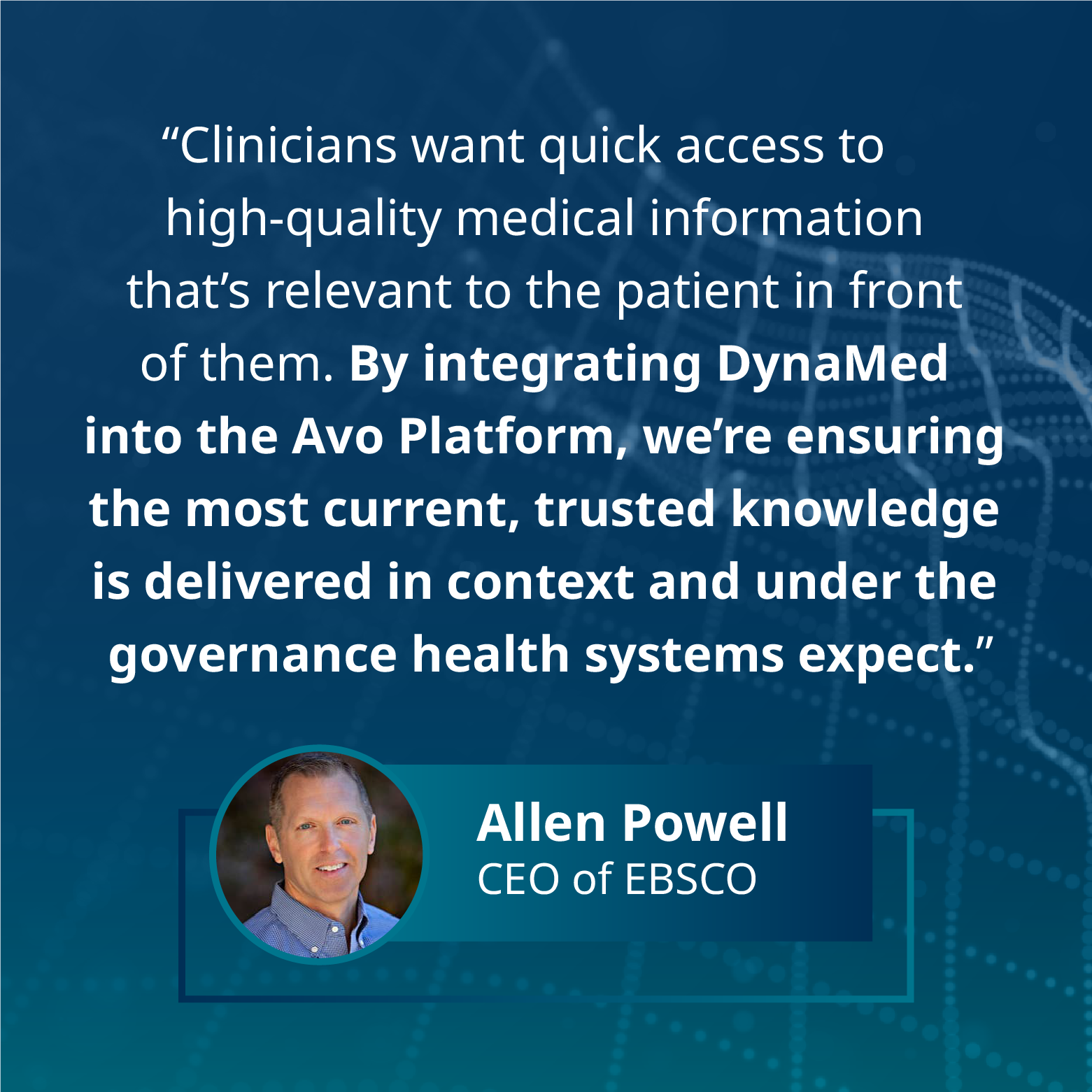
- AI-embedded clinical guidance — Avo: Most clinical AI tools generate answers without a defined, vetted evidence source underneath them. DynaMed's partnership with Avo changes that. Through Ask Avo — an AI chatbot embedded directly inside Epic, athenahealth, and MEDITECH — DynaMed's expert-curated knowledge base is combined with the patient's electronic health record (EHR) data to generate guidance that is both clinically grounded and patient specific. The result is AI that functions as a highly governed routing engine rather than a best-guess generator.
What Health Systems Should Demand from Every Clinical Integration at the Point of Care
The volume of clinical AI tools entering health system procurement conversations right now is significant. Most of them lead with interface, speed, and ease of deployment. Fewer lead with evidence governance.
To help close this gap, health system leaders should ask the following questions:
- Where does the content come from? The evidence source should be named, peer-reviewed, and independently maintained. If a vendor can't answer this clearly, that is itself an answer.
- How is it updated, and how fast? Clinical guidelines move quickly. Ask for a specific update frequency, not a general assurance that content is "current."
- What is the appraisal methodology? There should be a documented, transparent process for how evidence is selected, weighted, and reviewed.
- Who is responsible for maintaining it? Vendor relationships change. Understanding who owns the evidence layer and how it’s sustained long-term is part of evaluating reliability.
- How does it fit existing workflows? An integration that requires clinicians to change their behavior to access better evidence is unlikely to be used consistently. Inconsistent use is its own clinical risk.
- What happens when the evidence changes? Ask specifically how the tool handles a major guideline update or a landmark trial that contradicts current recommendations. The answer reveals how seriously a vendor treats content governance.
- Can it be audited? Health systems should be able to trace a recommendation back to its source. If that audit trail doesn't exist, the tool is not defensible in a compliance or quality review.
Related Read: DynaMed vs UpToDate: AI Clinical Decision Support Tools Comparison
The Bigger Implication for Clinical AI
As AI becomes a standard layer in clinical workflows, the question of what sits underneath it becomes a patient safety issue along with a product consideration. Health systems are already using AI tools to flag deteriorating patients, assist with documentation, and surface treatment recommendations. The more embedded these tools become, the harder it is to course-correct when the evidence layer beneath them turns out to be thin.
The partnerships a clinical decision support platform chooses to build are one of the clearest signals of what it values. A platform that invests in evidence-based governance (i.e., maintaining rigorous appraisal standards, updating content in near real time, and holding every partner integration to the same bar) is making a deliberate bet that clinical outcomes matter more than deployment speed.
That bet is the right one. Clinicians don't need more tools. They need tools they can trust. Ones where the answer they get at 2 AM in the middle of a difficult case is grounded in the same standard of evidence they would apply if they had an hour to research themselves.
Explore EBSCO Clinical-Decision-Support Solutions to learn more.